G1 Restrictions: What You Can and Cannot Do
You passed the knowledge test and you are holding a licence that comes with strings attached. Here is every one of them, and what happens when one snaps.

Greenhorn Driving School
Published August 12, 2026 · 12 min read
A G1 is a real driver’s licence. It is also the most conditional one Ontario issues, and the conditions are written in a way that catches people out. Most new G1 holders can recite two of them and guess at the rest, which is how a sixteen-year-old ends up driving themselves to a shift at 11:40 p.m. and finding out the hard way that the clock matters more than the driving did.
This is the full list, taken from what the Ministry of Transportation and the Official MTO Driver’s Handbook currently publish, along with what each one actually costs you if you break it. Where the ministry’s own pages word something two different ways, we say so instead of picking the version that sounds tidier.

4 years
The person beside you needs a full licence and at least four years of driving experience. They sit in the front passenger seat, and nobody else can.

Zero
Zero alcohol and zero drugs in your system while you drive. This is stricter than the limit for a fully licensed driver, and it is not negotiable.

Midnight to 5 a.m.
You cannot drive during those five hours at all. There is no exception for a supervising driver, and no exception for work or school.

12 or 8 months
You hold the G1 for 12 months before the G2 road test, or 8 months if you finish a government-approved driver education course.
The Short Answer
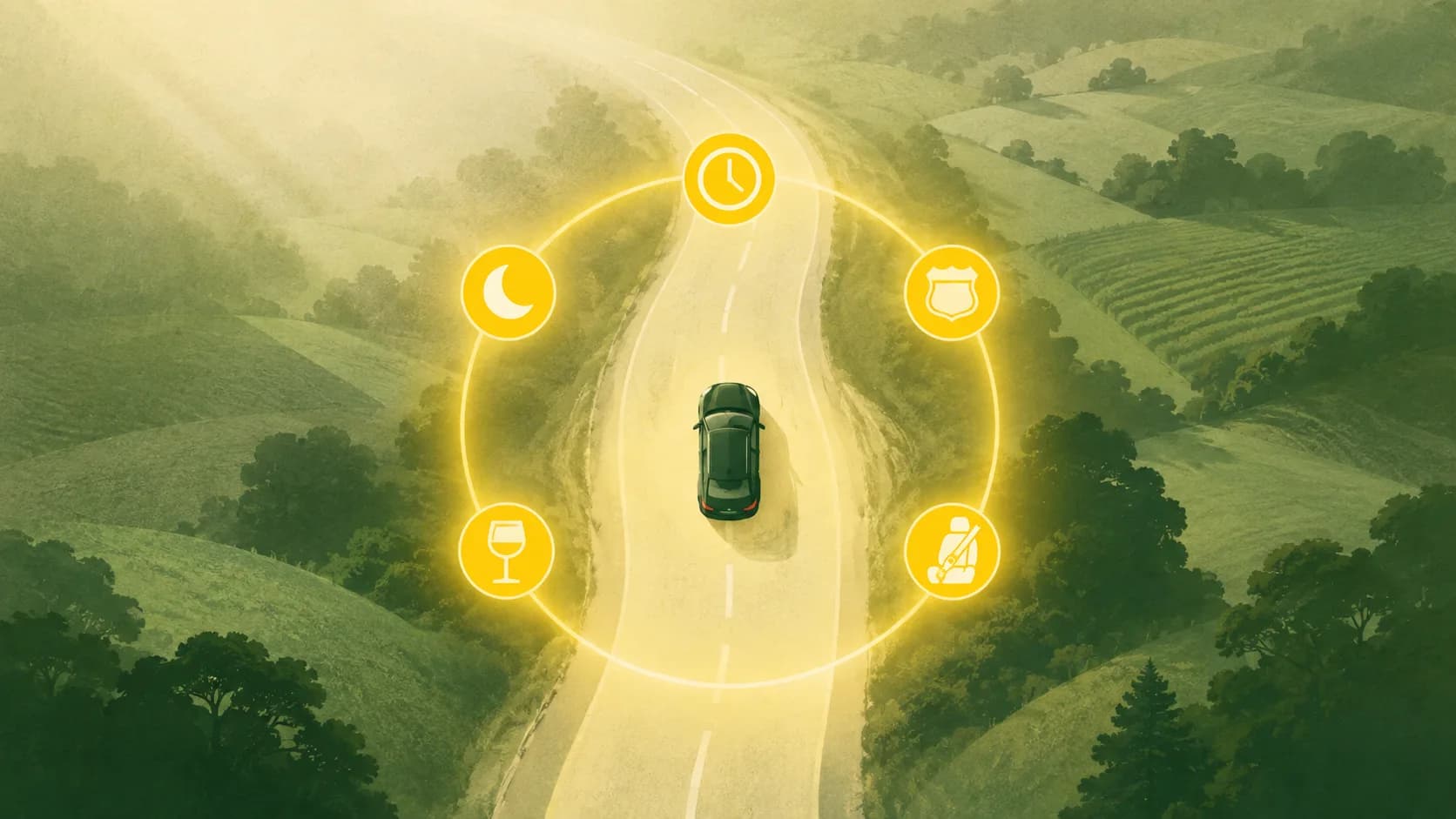
There are five G1 conditions. Everything else you have heard is either a detail hanging off one of them or somebody’s house rule.
The five conditions on a G1
- You must not drive alone. An accompanying driver has to be in the front passenger seat.
- Your blood alcohol level must be zero, and you must have no drugs in your system.
- Every person in the vehicle must have a working seatbelt.
- You must not drive between midnight and 5 a.m.
- You must not drive on 400-series highways or the named high-speed expressways, unless your accompanying driver is a licensed instructor.
Notice what is not on that list. There is no restriction on how many passengers you can carry beyond the seatbelt rule, no restriction on driving in bad weather, and no requirement to display any kind of learner sticker on the car. Ontario does not issue or require an L plate. If somebody tells you a G1 has a passenger limit, they are describing the G2 rules for drivers 19 and under, which are a different set entirely.
Who Has to Sit Beside You
This is the condition people get wrong most often, because they assume any licensed adult counts. The handbook is specific. Your accompanying driver must hold a valid Class G licence or higher, must have at least four years of driving experience, and must have a blood alcohol level below .05 while they are supervising you.
Two extra pieces sit on top of that. The ministry adds that if your accompanying driver is 21 or under, their blood alcohol level has to be zero rather than under .05, because Ontario’s young driver rule applies to them regardless of what class of licence they hold. And the handbook is explicit that the accompanying driver has to sit in the front passenger seat, and that they are the only person allowed in the front seat while you drive.
Qualifies
A full G, G2 upgraded years ago, or a higher class such as an A or D. Four or more years of driving experience. Sober enough to be under .05, or fully sober if they are 21 or under. Sitting in the front passenger seat.
Does not qualify
Another G2 driver. A licensed driver with three years of experience. Anyone sitting in the back seat while the front passenger seat is empty or occupied by someone else. A driver whose own licence is currently suspended.
One thing the ministry does not spell out
The published pages say four years of driving experience without defining how those four years are counted, so we are not going to invent a rule about whether time held at the G2 level counts toward it. If your supervising driver is anywhere near the four-year line, pick somebody who is clearly past it rather than betting on an interpretation.
Zero Alcohol and Zero Drugs
A fully licensed adult driver in Ontario is allowed to have some alcohol in their system. You are not. The rule for anyone holding a G1, G2, M1 or M2, and for every driver aged 21 and under regardless of licence class, is zero alcohol and zero drugs while driving. Cannabis is covered by the same rule, and legalisation changed nothing about it.
The enforcement side matters here more than most people realise. Since 2018, a police officer who has lawfully stopped you can demand a roadside breath sample without needing any reason to suspect you have been drinking. At a RIDE checkpoint that means everyone who is stopped, not just the drivers who seem off. For a fully licensed driver a small amount of alcohol produces nothing. For you it produces a suspension.
What a zero tolerance stop actually costs
Ontario increased these penalties on January 1, 2026, so any guide written before then understates them. A first occurrence is an immediate seven-day licence suspension, a $250 administrative penalty, a mandatory eight-hour education course, and a fine of $60 to $1,000 if you are convicted. A second occurrence is a fourteen-day suspension, a $350 penalty, and a sixteen-hour treatment program. A third is a thirty-day suspension, a $450 penalty, a sixteen-hour treatment program, and an ignition interlock condition for six months.
Those are the roadside consequences. A criminal conviction on top of them can add a further 30 or 90 day suspension or cancel your licence outright, depending on your age and licence class. None of this is discretionary and none of it is negotiated at the roadside.
The Roads You Cannot Use
A G1 driver is kept off the fastest roads in the province. The handbook’s wording is that you must not drive on 400-series highways with a posted speed limit over 80 km/h, and also must not drive on certain named high-speed roads: the Queen Elizabeth Way, the Don Valley Parkway and the Gardiner Expressway in the Greater Toronto Area, the E.C. Row Expressway in Windsor, and the Conestoga Parkway in Kitchener-Waterloo.
The ministry’s plain-language summary page drops the speed qualifier and simply says you must not drive on 400-series highways or high-speed expressways, giving the 401, the QEW and the Gardiner as examples. That difference is not academic. A handful of 400-series stretches are posted at 80 km/h, and the strict handbook reading would permit them while the summary page would not.
Our advice is to treat every 400-series highway as off limits. You gain almost nothing by finding the one legal kilometre of Highway 403, and an officer working from the summary version of the rule is not going to debate posted limits with you at the side of the road.
The instructor exception
There is exactly one way onto those roads with a G1. The handbook states that if your accompanying driver is a driving instructor, you may drive on any road. That is the whole reason first highway lessons happen in an instructor’s car: it is the only legal way for a G1 holder to get highway experience before the G2 test, and highway driving is a skill the G2 road test does not wait for you to develop later.
Midnight to 5 a.m.
You must not drive between midnight and 5 a.m. It is a flat five-hour window and it has no exceptions attached to it. Your accompanying driver cannot authorise it, a shift ending at 12:15 a.m. does not excuse it, and neither does an emergency.
People misread this rule in one specific way: they treat it as a rule about darkness. It is not. In late December it is fully dark by 5 p.m. and driving then is perfectly legal. In late June the sun is up before 5:30 a.m. and driving at 5:15 a.m. is still a violation. The clock is the rule.
The practical version, if you are planning around it: be parked by 11:30 p.m. That buffer costs you nothing, and a delay on the way home is a bad time to discover you misjudged the drive by twenty minutes.
Passengers and Seatbelts
The handbook puts this simply: each person in the vehicle must have a working seatbelt. The ministry’s summary page phrases the same requirement as making sure every passenger with you wears a properly working seatbelt.
Read together, that sets a ceiling without stating a number. You can carry as many passengers as the car has functioning seatbelts, and not one more. A five-seat car with a broken rear belt carries four people while you are driving it. There is no separate G1 passenger cap beyond that, and no restriction on who your passengers are.
The front seat is the part that trips people up, and it belongs to the accompanying driver alone. Your friend cannot ride up front while a qualified supervisor sits behind you. That arrangement breaks the accompanying driver condition even though everyone in the car is belted and a qualified driver is present.
How Long the G1 Lasts
Level One lasts 12 months before you are eligible for the G2 road test. That is the default and it is a waiting period rather than a target: passing the test earlier is not possible no matter how much you have practised.
The one way to shorten it is a government-approved driver education course, which brings the wait down to eight months. Four months is a meaningful amount of a teenager’s life, and it is the reason most students who intend to take a course book it early rather than partway through the year. Beginner Driver Education is also the thing insurers look for later, so the time saving is not the only return on it, but the eight-month figure is the part the ministry publishes and the part you can plan around.
Whichever route you take, the G2 road test is a separate booking and a separate fee from anything you have already paid. We covered how that money actually breaks down in our guide to G1 booking and fees.
The Five-Year Clock
Behind the 12-month wait sits a longer deadline that far fewer people know about. You have five years to complete the entire graduated licensing process, from the day you get your G1 to the day you hold a full G. Miss it and the process does not pause. It resets.
The ministry does give you an exit ramp. If your G1 is about to expire and you have not finished, you can requalify and keep the same class of licence by passing a test and paying the five-year licensing fee. A notice goes out to G1, G2 and M2 drivers before their expiry date setting out the options, so this is not something you are expected to track alone.
What you cannot do is ignore both. If you neither complete the process nor requalify before your G1 expires, you no longer have a licence to drive and you have to reapply for a Level One licence from scratch. Every fee and every month of waiting you had banked goes with it.
What Breaking a Condition Costs
Novice drivers are punished on a different scale from fully licensed ones, and the gap is wider than most people expect. There are three separate systems that can catch you, and they run at the same time rather than instead of each other.
Violating a G1 condition
Get convicted of breaking one of the five conditions and your licence is suspended for 30 days. That applies to driving alone, driving at 1 a.m., driving on the QEW, or any of the others.
Repeat it and the Novice Driver Escalating Sanctions take over. These are triggered by repeat violations of novice conditions, by any Highway Traffic Act conviction carrying four or more demerit points, or by a court-ordered suspension for an offence that would have carried four or more points. A first occurrence is a 30-day suspension, a second is 90 days, and a third costs you the novice licence entirely. At that point you reapply and start over, taking every test again and paying every fee again, and you lose any time credit you had built up along the way.
Demerit points
The demerit thresholds for a novice driver sit at roughly half those for a fully licensed one. At 2 to 5 points you get a warning letter. At 6 to 8 points you get a second one. At 9 or more accumulated in a two-year period your licence is suspended for 60 days, where a fully licensed driver would need 15 points to face a 30-day suspension. Points stay on your record for two years from the date of the offence, not from the date you were convicted.
Which offences carry which points, and how the record actually works, is laid out in our complete guide to demerit points in Ontario.
Distracted driving
This one is worth calling out separately because it is the offence a new driver is statistically most likely to commit, and because novice drivers are handled differently from everyone else. A first conviction is a fine of $615 if settled out of court, or up to $1,000, plus a 30-day licence suspension. A second is a fine of up to $2,000 and a 90-day suspension. A third is a fine of up to $3,000, cancellation of your licence, and removal from the Graduated Licensing System.
Novice drivers do not receive demerit points for distracted driving. They receive those suspensions instead, which is a harsher outcome dressed up as a lighter one.
Still Working Toward the G1 Itself?
Our G1 practice test is free, has no ads, and needs no account. 200 questions covering road signs and rules of the road, a full mock test in the real format, an explanation on every answer, and unlimited retakes.

What People Actually Get Wrong
After enough students have gone through Level One, the same handful of misunderstandings come up again and again.
- Treating the midnight rule as a darkness rule. It is a clock, and it does not move with the seasons.
- Assuming any licensed adult can supervise. Four years of experience and a full licence, not just a pulse and a wallet.
- Putting a friend in the front seat. That seat belongs to the accompanying driver and to nobody else while you are driving.
- Thinking a short trip does not count. Moving the car to the end of the street alone is driving alone, and it carries the same 30-day suspension.
- Believing one drink is fine because a licensed adult could have one. Your limit is zero, and a RIDE stop does not need a reason to check.
- Forgetting the five-year deadline exists. It is long enough to feel irrelevant right up until it is not.
Where these rules come from
Every figure on this page is taken from the Ministry of Transportation’s published material: getting a G driver’s licence, the Official MTO Driver’s Handbook, Ontario’s impaired driving penalties, understanding demerit points, and distracted driving. Rules and penalty amounts do change, so check the ministry’s pages before relying on a figure for anything that matters.
The rest of the G1 series

What to expect at your G1 test
The ID they check, the vision screening, and how it is marked.

G1 booking and fees
Why you cannot book, and what the licence package covers.

Demerit points in Ontario
What each offence costs you, and how the record works.

Every language the G1 test is offered in
All 32, plus how the free audio option works.
Common Questions About G1 Restrictions
No. A G1 driver must never drive alone. An accompanying driver with a full licence and at least four years of driving experience has to be in the front passenger seat every time the car moves, whether the trip is two minutes or two hours. There is no exemption for commuting, for errands, or for an emergency.
Yes, as long as they qualify as an accompanying driver. That means a valid full Class G licence or higher, at least four years of driving experience, and a blood alcohol level under .05 while they are supervising you. If your parent is 21 or under, their blood alcohol level has to be zero. Being a parent is not what qualifies them. The licence and the four years are.
You can drive after dark, but not between midnight and 5 a.m. The night restriction is a fixed window of time rather than a rule about darkness, so a 9 p.m. drive in December is fine and a 1 a.m. drive in June is not. Having a qualified accompanying driver beside you does not lift it.
Yes. This is the single exception to the highway restriction. Ontario’s driver handbook states that if your accompanying driver is a driving instructor, you may drive on any road. That is why a first highway lesson almost always happens in an instructor’s car rather than the family one.
You will be asked for your licence, and since 2018 an officer can require a roadside breath sample from any driver they have lawfully stopped, without needing to suspect you have been drinking. Because you are a novice driver, any alcohol at all counts. A first occurrence means an immediate seven-day licence suspension and a $250 penalty, plus a fine of $60 to $1,000 if you are convicted. Your accompanying driver can also be asked for a sample if the officer suspects they have been drinking.
Yes. You have five years to finish the whole graduated licensing process. If your G1 is about to expire and you have not moved up, you can requalify by passing a test and paying the five-year licensing fee, and the ministry sends a notice before the expiry date. If you neither finish nor requalify in time, you have no licence and you reapply for a Level One licence from the beginning.